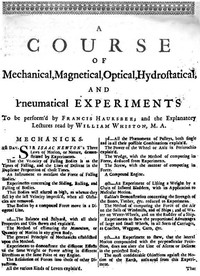
A Course of Mechanical, Magnetical, Optical, Hydrostatical and Pneumatical Experiments perform'd by Francis Hauksbee, and the Explanatory Lectures read by William Whiston, M.A.
"A Course of Mechanical, Magnetical, Optical, Hydrostatical and Pneumatical Experiments" by Francis Hauksbee is a scientific publication written in the early 18th century. The work presents a series of experiments and demonstrations related to various scientific principles, including mechanics and optics. It aims to elucidate natural philosophy concepts, primarily focusing on the laws of physics as demonstrated through practical experimentation. The opening of the text introduces readers to various experiments conducted over multiple days, beginning with the foundational laws of motion established by Sir Isaac Newton. Hauksbee outlines experiments designed to observe the behavior of falling bodies, utilize levers and pulleys, and explore the properties of gravity and forces in motion. Further, there are detailed explanations of subsequent days focusing on magnetism, optics, hydrostatics, and pneumatics, including experiments that illustrate principles such as the reflection and refraction of light and the behaviors of fluids in various conditions. Overall, the beginning sets a rigorous and systematic approach to understanding these scientific phenomena through experimentation.
Bookshelves
Related books
Natuurkunde in de Huiskamer: ongeveer 100 proeven met huishoudelijke voorwerpen.
Tom Tit
The Complete Works in Philosophy, Politics and Morals of the late Dr. Benjamin Franklin, Vol. 1 [of 3]
Benjamin Franklin
The Complete Works in Philosophy, Politics and Morals of the late Dr. Benjamin Franklin, Vol. 2 [of 3]
Benjamin Franklin
The Complete Works in Philosophy, Politics and Morals of the late Dr. Benjamin Franklin, Vol. 3 [of 3]
Benjamin Franklin
Elémens de la philosophie de Neuton: Mis à la portée de tout le monde
Voltaire
Grounds of Natural Philosophy: Divided into Thirteen Parts The Second Edition, much altered from the First, which went under the Name of Philosophical and Physical Opinions
Margaret Cavendish Newcastle