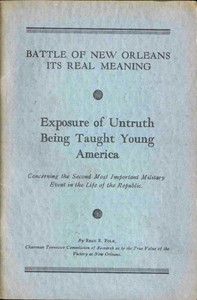
Battle of New Orleans: Its Real Meaning
"Battle of New Orleans: Its Real Meaning" by Reau E. Folk is a historical account published in the early 20th century that seeks to clarify the significance of the Battle of New Orleans, fought on January 8, 1815. The book argues against the prevailing idea that this battle was unnecessary and fought after peace had been established with the signing of the Treaty of Ghent. Folk contends that the battle was not only fought during a state of war but was also crucial in securing the Louisiana Purchase and establishing U.S. sovereignty against British claims. In this work, Folk critiques American school histories that describe the Battle of New Orleans as a needless victory, highlighting the misconceptions surrounding its timing in relation to the Treaty of Ghent. He provides evidence that the battle was essential to prevent British occupation of the captured territory and discusses how the victory restored national self-respect and altered the nation's trajectory. Folk’s research illustrates that the British had intentions of retaining control over Louisiana, which would have serious implications for American territorial integrity. Ultimately, the book serves as a call to revise educational narratives about the War of 1812, advocating for a more truthful representation of the battle's critical role in American history.
Related Subjects
Bookshelves
Related books
The Battle of New Orleans including the Previous Engagements between the Americans and the British, the Indians and the Spanish which led to the Final Conflict on the 8th of January, 1815
Z. F. (Zachariah Frederick) Smith
Tennessee at the Battle of New Orleans
Elbert L. Watson
The Naval War of 1812 Or the History of the United States Navy during the Last War with Great Britain to Which Is Appended an Account of the Battle of New Orleans
Theodore Roosevelt
The Campaigns of the British Army at Washington and New Orleans 1814-1815
G. R. (George Robert) Gleig