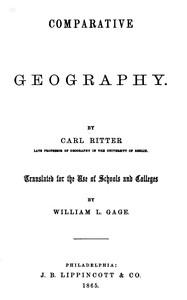
Comparative geography
by Carl Ritter
"Comparative Geography" by Carl Ritter is a scientific publication written in the mid-19th century. The work serves as an expansive exploration of geographical science, delving into the relationships between the Earth, its features, and humanity. It emphasizes the importance of understanding geography not merely as a collection of facts or a description of the Earth’s surface, but as a comprehensive science that integrates time, space, and human activity. The opening of the text introduces the fundamental concepts underlying Ritter's philosophy of geography. It starts with a discussion of the Earth's position within the solar system, defining geography as the study of the Earth as the dwelling place of humanity. Ritter aims to evaluate the Earth from multiple perspectives, emphasizing interconnectivity among its features, including the atmospheric, hydrological, and geological factors. He addresses the historical significance of geographical knowledge, asserting that understanding the relationships among these factors is essential for comprehending both human civilization and the natural world. The text seeks to establish a foundation for a scientific approach to geography, rooted in empirical observation and the study of nature’s intricate web of interactions.
Related Subjects
Related books
Landscape in History, and Other Essays
Archibald Geikie
The Beauties of Nature, and the Wonders of the World We Live In
John Lubbock
The Adventures of a Grain of Dust
Hallam Hawksworth
Aspects of nature, in different lands and different climates (Vol. 1 of 2) with scientific elucidations
Alexander von Humboldt
Aspects of nature, in different lands and different climates (Vol. 2 of 2) with scientific elucidations
Alexander von Humboldt
Cosmos: A Sketch of the Physical Description of the Universe, Vol. 1
Alexander von Humboldt
Views of nature: or Contemplations on the sublime phenomena of creation with scientific illustrations
Alexander von Humboldt
Man and Nature; Or, Physical Geography as Modified by Human Action
George P. (George Perkins) Marsh