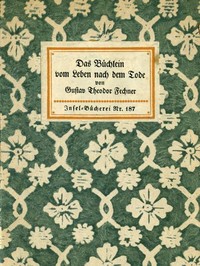
Das Büchlein vom Leben nach dem Tode
"Das Büchlein vom Leben nach dem Tode" by Gustav Theodor Fechner is a philosophical exploration written in the early 19th century. The work delves into the nature of human existence, the concept of life after death, and the relationship between the physical and the spiritual realms. Fechner proposes a nuanced understanding of life as a multi-dimensional journey, transitioning through different stages from birth to an eternal existence. The opening of the work presents Fechner's idea that human life can be conceptualized as consisting of three stages. The first stage represents a state of ignorance and isolation, the second is characterized by social interaction and the limitations of physical existence, while the third stage signifies a higher state of awareness and connection with the divine. He likens the experience of death to a birth into this new, expansive existence, emphasizing the continuity of the soul's development. Fechner argues for a philosophy that harmonizes belief in a spiritual reality with empirical observations, suggesting that our actions in this life shape our experiences in the hereafter. This establishes a profound framework for understanding the journey of the human soul beyond death, positioning the reader to contemplate the deeper implications of existence and the nature of consciousness.
Related Subjects
Related books
Life Everlasting
John Fiske
The Destiny of Man, Viewed in the Light of His Origin
John Fiske
The little book of life after death
Gustav Theodor Fechner
Immortality proved by the testimony of sense : $b In which is contemplated the doctrine of spectres and the existence of a particular spectre
Abraham Cummings
Pagan Ideas of Immortality During the Early Roman Empire
Clifford Herschel Moore
Kuolema ja kuolematon
Arthur Schopenhauer
The Egyptian Conception of Immortality The Ingersoll Lecture, 1911
George Andrew Reisner
Human Personality and Its Survival of Bodily Death
F. W. H. (Frederic William Henry) Myers