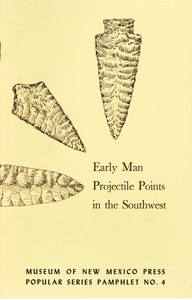
Early Man Projectile Points in the Southwest
"Early Man Projectile Points in the Southwest" by Kenneth Honea is a scientific publication written in the mid-20th century. This work provides an in-depth examination of the various types of projectile points utilized by early human populations in the Southwest region of the United States. It likely delves into the archaeological significance of these points, including their design and manufacturing methods, while situating them within the broader context of early human hunting practices. The book meticulously categorizes several projectile point types associated with early humans, offering detailed descriptions of their shapes, sizes, and manufacturing techniques. Honea discusses the cultural significance of points such as Blanco, Sandia, Clovis, Folsom, and many others, outlining their distinct characteristics and geographical distributions. He highlights the connection between these artifacts and the hunting strategies employed during the Pleistocene era, emphasizing the technological advancements in tool-making and how these advancements reflect the adaptability and creativity of early peoples in their pursuit of survival in diverse environments.
Related Subjects
Bookshelves
Related books
The Indians of the Painted Desert Region: Hopis, Navahoes, Wallapais, Havasupais
George Wharton James
Stone Art Thirteenth Annual Report of the Bureau of American Ethnology to the Secretary of the Smithsonian Institution, 1891-1892, Government Printing Office, Washington, 1896, pages 47-178.
Gerard Fowke
The Indians of Carlsbad Caverns National Park
Jack R. Williams
North American Stone Implements
Charles Rau
The dread Apache: That early-day scourge of the Southwest
Merrill Pingree Freeman
Fire-making Apparatus in the U. S. National Museum
Walter Hough