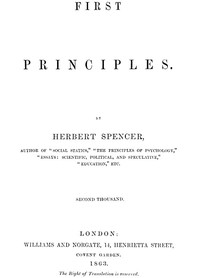
First Principles
"First Principles" by Herbert Spencer is a philosophical treatise written in the mid-19th century. The work is part of a larger series that aims to establish a systematic understanding of philosophy grounded in science, religion, and human experience. It explores the interplay between religion and science, seeking to reconcile their seemingly opposing views on existence and knowledge, and discusses the underlying truths present across various belief systems. The opening of the treatise introduces the ambitious scope of Spencer’s work, as he presents a framework for his philosophical inquiry. He begins with a discussion on the nature of human beliefs, suggesting that even widely-held misconceptions may contain elements of truth. By analyzing the historical perspectives on authority and governance, Spencer underscores the evolution of political thought from divine kingship to modern democratic ideals. He proposes that there is a common thread among all religions and philosophies — the acknowledgment of fundamental truths concerning existence that are often obscured by dogma. Thus, the groundwork is laid for his exploration of "the unknowable" and the "laws of the knowable," setting the stage for a deeper analysis of both the limitations and possibilities of human understanding.
Related Subjects
Bookshelves
Related books
Darwinism (1889) An exposition of the theory of natural selection, with some of its applications
Alfred Russel Wallace
The Gospel of Evolution From "The Atheistic Platform", Twelve Lectures
Edward B. Aveling
Die Religion innerhalb der Grenzen der bloßen Vernunft Text der Ausgabe 1793, mit Beifügung der Abweichungen der Ausgabe 1794
Immanuel Kant
Kant-breviarium: Kant világnézete és életfelfogása
Immanuel Kant
Kritik der reinen Vernunft (Erste Fassung 1781)
Immanuel Kant
Kritik der reinen Vernunft Zweite hin und wieder verbesserte Auflage (1787)
Immanuel Kant
The Critique of Pure Reason
Immanuel Kant
Evolution made plain
John (John Harmon) Mason