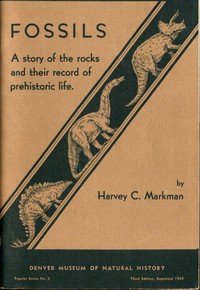
Fossils: A Story of the Rocks and Their Record of Prehistoric Life
"Fossils: A Story of the Rocks and Their Record of Prehistoric Life" by Harvey C. Markman is a scientific publication written in the mid-20th century. This work serves as both a guide to understanding fossils and a narrative exploring the deep history of life displayed in geological formations. It aims to bridge the gap between scientific terminology and layman curiosity about prehistoric life, catering to readers interested in natural history. The opening of the book introduces the reader to the significance of fossils in understanding prehistoric life, asserting that the history of extinct plants and animals is largely constructed from the study of rock formations. It explains the basic processes of fossilization, the types of fossils that can be found, and the geological principles that govern their preservation. The introduction emphasizes the interplay between scientific exploration and public interest, preparing the foundation for a deeper dive into various geological eras, and highlighting the mysteries of earth's history as recorded in rocks.
Related Subjects
Related books
The Geographical Distribution of Animals, Volume 1 With a study of the relations of living and extinct faunas as elucidating the past changes of the Earth's surface
Alfred Russel Wallace
The Geographical Distribution of Animals, Volume 2 With a study of the relations of living and extinct faunas as elucidating the past changes of the Earth's surface
Alfred Russel Wallace
Grundzüge der Paläontologie (Paläozoologie). 1. Abteilung: Invertebrata.
Karl Alfred von Zittel
Grundzüge der Paläontologie (Paläozoologie). 2. Abteilung: Vertebrata.
Karl Alfred von Zittel
Extinct Monsters A Popular Account of Some of the Larger Forms of Ancient Animal Life
H. N. (Henry Neville) Hutchinson
Some Salient Points in the Science of the Earth
John William Dawson
The Chain of Life in Geological Time A Sketch of the Origin and Succession of Animals and Plants
John William Dawson
The Story of the Earth and Man
John William Dawson