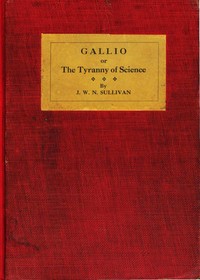
Gallio : $b or, The tyranny of science
by J. W. N. (John William Navin) Sullivan
"Gallio : or, The tyranny of science by J. W. N. Sullivan" is a philosophical essay of cultural criticism written in the early 20th century. The book examines the growing prestige of science and challenges its claim to define reality, especially where it sidelines art, morals, and spiritual experience. Its likely topic is the limits of scientific method and the need to recognize values, purpose, and imagination as central to human knowledge. The essay opens with the rise of scientific authority from Darwin to Einstein, noting how artists first resisted and then, after the War, often embraced a bleak materialism. It argues that modern physics—especially relativity—undermines the old “iron laws,” showing that scientific laws are mind-shaped selections from a world of “point-events,” and that science offers only partial, abstract descriptions of reality. Sullivan criticizes the fetish of measurement and the misuse of scientific prestige in fields like eugenics, crude psychoanalysis, and behaviourism, as well as the fallacy of “explaining by origins.” He urges humility before quantum mysteries and calls for richer abstractions, drawing on thinkers like Eddington and Whitehead to replace “substance” with “organism” and to reconnect space, time, memory, and expectation. Art—especially music—is presented as a mode of genuine knowledge that reveals possibilities of the spirit and anticipates human growth. The book closes by denying that science should tyrannize culture: its scope is limited, its laws are provisional and self-referential, and it is largely irrelevant to the deepest moral and spiritual concerns.
Related Subjects
Related books
An Address to Men of Science Calling Upon Them to Stand Forward and Vindicate the Truth....
Richard Carlile
The Old Humanities and the New Science
William Osler
Aus der Schneegrube
Wilhelm Bölsche
Von Sonnen und Sonnenstäubchen : $b Kosmische Wanderungen
Wilhelm Bölsche
Thoughts on Art and Life
da Vinci Leonardo
Common Science
Carleton Washburne
Aphorisms and Reflections from the works of T. H. Huxley
Thomas Henry Huxley
Autobiography and Selected Essays
Thomas Henry Huxley