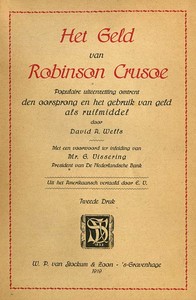
Het Geld van Robinson Crusoe Populaire uiteenzetting omtrent den oorsprong en het gebruik van geld als ruilmiddel
"Het Geld van Robinson Crusoe" by David A. Wells is a treatise on the origins and use of money as a medium of exchange, written in the early 20th century. The work utilizes the narrative of Robinson Crusoe to explore complex economic concepts in an accessible manner. Wells employs Crusoe's fictional experience on an isolated island to illustrate the evolution of monetary systems and the functionalities of money, providing insights on wealth, value, and the history of finance. The beginning of the text sets the stage by highlighting the importance of understanding money amidst economic turmoil, as experienced in the United States following the Civil War. The narrative opens with Crusoe discovering valuable items from a shipwreck, including three bags of money, which he dismisses as worthless in his survival context. This leads into a discussion of what constitutes wealth and value, demonstrating that while material goods can aid in comfort and happiness, money lacks inherent utility when divorced from a structured society that recognizes its worth. The introduction establishes the foundation for exploring how society derives meaning and value from money as it progresses through various economic phases.
Related Subjects
Bookshelves
Related books
Honest Money
Arthur Isaac Fonda
Emerson on Sound Money A Speech, 1896
Willis George Emerson
The Value of Money
Benjamin M. (Benjamin McAlester) Anderson
Tolstoy's interpretation of money and property
Milivoy S. (Milivoy Stoyan) Stanoyevich
Seventeen Talks on the Banking Question Between Uncle Sam and Mr. Farmer, Mr. Banker, Mr. Lawyer, Mr. Laboringman, Mr. Merchant, Mr. Manufacturer
Charles N. (Charles Newell) Fowler
A Tract on Monetary Reform
John Maynard Keynes
Economisti del cinque e seicento
Geminiano Montanari
Robinson Crusoe's Money; or, The Remarkable Financial Fortunes and Misfortunes of a Remote Island Community
David Ames Wells