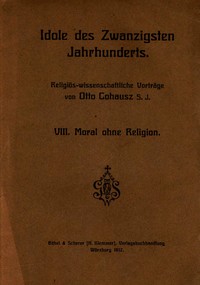
Idole des Zwanzigsten Jahrhunderts. VIII. Moral ohne Religion Religiös-wissenschaftliche Vorträge
by Otto Cohausz
"Idole des Zwanzigsten Jahrhunderts. VIII. Moral ohne Religion" by Otto Cohausz is a philosophical and theological treatise written in the early 20th century. The book discusses the concept of morality in a modern context, where religious values are increasingly rejected. Cohausz argues that without a divine basis for moral principles, society is left in confusion regarding ethical standards. In this work, Cohausz contends that moral values traditionally stem from religious teachings, specifically those of Christianity, and without this foundation, there is a chaotic array of conflicting moral philosophies. He critiques various modern ethical frameworks, emphasizing the need for an absolute norm of morality, which he argues can only be provided by God. The text ultimately defends the necessity of a theistic moral framework to guide human behavior, suggesting that true morality cannot exist independently of religious belief. Through his arguments, Cohausz warns of the consequences of separating morality from its divine origin, painting a picture of societal decay without a shared moral foundation.
Related Subjects
Bookshelves
Related books
The Agony of the Church (1917)
Nikolaj Velimirović
Christ, Christianity and the Bible
Isaac Massey Haldeman
Christianity and Problems of To-day: Lectures Delivered Before Lake Forest College on the Foundation of the Late William Bross
John H. (John Huston) Finley
The Religious Situation
Goldwin Smith
Some Christian Convictions A Practical Restatement in Terms of Present-Day Thinking
Henry Sloane Coffin