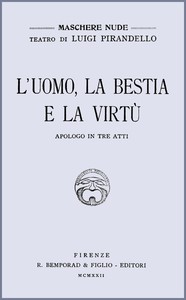
L'uomo, la bestia e la virtù
"L'uomo, la bestia e la virtù" by Luigi Pirandello is a play written in the early 20th century. The work delves into themes of morality, social norms, and human behavior, revolving around the complexities of love and betrayal. The main characters include the virtuous Mrs. Perella, who finds herself ensnared in a morally ambiguous situation with her lover, Mr. Paolino, and her husband, Captain Perella, who represents the more base instincts of humanity. The opening of the play introduces us to a modest room inhabited by Mr. Paolino, a private teacher, and showcases a bustling household atmosphere. We meet key players including Rosaria, a servant, and Totò, a pharmacist, who display lively banter indicating a close-knit yet chaotic environment. As the scene unfolds, Paolino's fiery temperament and his philosophical musings on civilization highlight the tension between the expectations of society and the inherent nature of people. The arrival of the future events is foreshadowed with the mention of Captain Perella, who will soon return, bringing with him the potential for significant turmoil in the narrative.
Related Subjects
Bookshelves
Related books
The Follies of a Day; or, The Marriage of Figaro A comedy, as it is now performing at the Theatre-Royal, Covent-Garden. From the French of M. de Beaumarchais
Pierre Augustin Caron de Beaumarchais
Die Tugend auf der Schaubühne oder: Harlekins Heirath; Ein Nachspiel in einem Aufzuge
Justus Möser
Minna von Barnhelm Viisinäytöksinen huvinäytelmä
Gotthold Ephraim Lessing
Kirkkopatruuna : $b Multa-aatelia IV : 3-näytöksinen huvinäytelmä
Kaarle Halme
Pöllönkorven naamiaisyö : $b Kolminäytöksinen huvinäytelmä
Kaarle Halme
Der Zerbrochene Krug
Heinrich von Kleist
The Unforseen Return
Jean-François Regnard
The Devil is an Ass
Ben Jonson