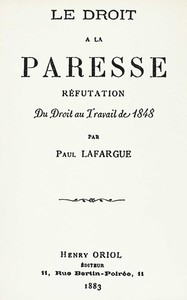
Le droit à la paresse : $b réfutation du droit au travail de 1848
Le droit à la paresse : réfutation du droit au travail de 1848 by Paul Lafargue is a political-economic essay and socialist polemic written in the late 19th century. It challenges the capitalist cult of work and the liberal “right to work,” instead advocating the right to leisure as a foundation for human flourishing. The book denounces the moral, religious, and economic glorification of labor, arguing that overwork degrades bodies and minds, exploits women and children, and fuels overproduction, crises, and poverty. Drawing on historical contrasts with ancient disdain for servile toil, factory reports of brutal hours, and the absurdities of bourgeois consumption and colonial expansion, it claims machines should liberate people rather than enslave them. It calls to ration labor across the year, reduce daily work to three hours, expand rest and festivals, and raise workers’ consumption so production serves life. A satirical finale and an appendix of classical authorities reinforce the central demand: reject the “right to work,” and embrace leisure as the mother of arts and virtues.
Related Subjects
Related books
Everybody's Business Is Nobody's Business Or, Private Abuses, Public Grievances; Exemplified in the Pride, Insolence, and Exorbitant Wages of Our Women, Servants, Footmen, &c.
Daniel Defoe
Labour and the Popular Welfare
W. H. (William Hurrell) Mallock
The Personal Relation in Industry
John D. Rockefeller
Statement of the Provision for the Poor, and of the Condition of the Labouring Classes in a Considerable Portion of America and Europe Being the preface to the foreign communications contained in the appendix to the Poor-Law Report
Nassau William Senior
Practicable Socialism, New Series
S. A. (Samuel Augustus) Barnett
Practicable Socialism: Essays on Social Reform
S. A. (Samuel Augustus) Barnett
The right to be lazy, and other studies
Paul Lafargue
The rise, progress, and phases of human slavery How it came into the world and how it shall be made to go out
James Bronterre O'Brien