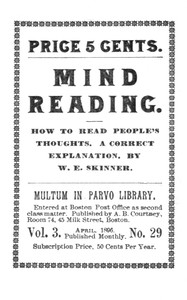
Mind reading : $b How to read people's thoughts
"Mind reading : How to read people's thoughts by W. E. Skinner" is a practical guide written in the late 19th century. The book belongs to the category of instructional manuals and is aimed at demystifying the performance of mind reading, particularly as it was popular in parlors and stage acts of the era. Rather than exploring psychic or mystical interpretations, the book focuses on the technique called "muscle reading" and explains how so-called mind readers achieve their feats in public exhibitions. The likely topic centers on exposing and teaching the practical methods behind apparent mind reading tricks. The main content of the book provides step-by-step explanations of how to execute popular mind reading acts, such as finding hidden objects, identifying keys on a piano, or writing names thought of by others. Skinner clarifies that these feats rely on observing involuntary muscle movements and resistance from the person whose mind is supposedly being read, rather than any supernatural ability. He offers practical advice on choosing compliant subjects, practicing techniques, and improving performance. Alongside the main instructional material, the book also contains a number of unrelated anecdotes, advertisements, and light-hearted poems, making it both a manual and a periodical filled with miscellaneous content typical of affordable publications of its time.
Related Subjects
Bookshelves
Related books
How to Do Mechanical Tricks Containing Complete Instruction for Performing Over Sixty Ingenious Mechanical Tricks
A. Anderson
Hanky Panky : $b A book of conjuring tricks
Wiljalba Frikell
More Conjuring: Simple Tricks for Social Gatherings
Hercat
The Practical Magician and Ventriloquist's Guide A practical manual of fireside magic and conjuring illusions, containing also complete instructions for acquiring and practising the art of ventriloquism.
Anonymous
The Magician's Own Book, or, the Whole Art of Conjuring Being a complete hand-book of parlor magic, and containing over one thousand optical, chemical, mechanical, magnetical, and magical experiments, amusing transmutations, astonishing sleights and subtleties, celebrated card deceptions, ingenious tricks with numbers, curious and entertaining puzzles, together with all the most noted tricks of modern performers.
George Arnold
Latest Magic, Being original conjuring tricks
Professor Hoffmann
Peerless prestidigitation : $b Being a collection of entirely new ideas and effects in the fascinating art of modern magic
Herbert De Caston