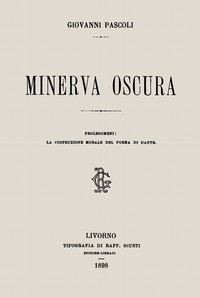
Minerva oscura Prolegomeni: la costruzione morale del poema di Dante
"Minerva oscura" by Giovanni Pascoli is a critical examination written in the late 19th century. This work dives into the complexities of Dante Alighieri's Divine Comedy, particularly focusing on the moral construction of the poem and its interpretation. The author appears to explore the deep philosophical and allegorical meanings embedded in Dante's writing, aiming to provide readers with a new perspective on the intricacies of Dante's thought and artistic expression. The opening of "Minerva oscura" presents an introduction where Pascoli expresses his long-standing contemplation regarding Dante's work, referencing previous publications and personal reflections. He describes his initial ambitions for glory in uncovering Dante’s mysteries, only to shift towards a more humble aspiration for understanding and appreciation. As he sets the stage for his analysis, he highlights the profound moral and philosophical depths within Dante's Inferno, indicating that the full comprehension of Dante's genius requires diligent exploration of its layers and meanings. Throughout this introductory section, Pascoli underscores the enduring struggle to grasp the essence of Dante’s vision, establishing the fundamental themes he will explore in his study.
Related Subjects
Related books
Dante: "The Central Man of All the World" A Course of Lectures Delivered Before the Student Body of the New York State College for Teachers, Albany, 1919, 1920
John T. (John Theodore) Slattery
An Irish precursor of Dante : $b a study on the Vision of Heaven and Hell ascribed to the eighth-century Irish saint Adamnán, with translation of the Irish text
Charles Stuart Boswell
Il Comento alla Divina Commedia, e gli altri scritti intorno a Dante, vol. 1
Giovanni Boccaccio
Il Comento alla Divina Commedia, e gli altri scritti intorno a Dante, vol. 2
Giovanni Boccaccio
Il Comento alla Divina Commedia, e gli altri scritti intorno a Dante, vol. 3
Giovanni Boccaccio
Sotto il velame: Saggio di un'interpretazione generale del poema sacro
Giovanni Pascoli