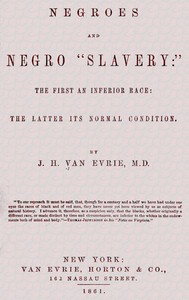
Negroes and Negro "Slavery:" the first an inferior race: the latter its normal condition.
"Negroes and Negro 'Slavery:' the first an inferior race: the latter its normal condition" by J. H. Van Evrie, M.D. is a controversial treatise written in the mid-19th century. The work argues against the abolitionist movement, asserting that it is based on erroneous beliefs about racial equality and the nature of slavery. The author positions the black race as inherently inferior and maintains that slavery is the natural condition for those of African descent. At the start of the book, the author presents a preface discussing the political and social turmoil in America amid the rising anti-slavery sentiment and the onset of the Civil War. He critiques the abolitionist movement as rooted in delusion and foreign influence, particularly from European ideals. Van Evrie aims to provide a justification for the existing social order in the southern United States, asserting that it is rooted in natural law and necessity rather than moral failing. He sets the stage for a detailed exploration of the supposed differences between races, intending to argue for the social subordination of African Americans as not just preferable but essential for societal stability.
Bookshelves
Related books
Lectures on the Philosophy and Practice of Slavery As Exhibited in the Institution of Domestic Slavery in the United States, with the Duties of Masters to Slaves
William A. (William Andrew) Smith
American slavery, and the means of its abolition
Jonathan Ward
Memories of Childhood's Slavery Days
Annie L. Burton
The Uprising of a Great People The United States in 1861. to Which is Added a Word of Peace on the Difference Between England the United States.
Agénor Gasparin
American Scenes, and Christian Slavery A Recent Tour of Four Thousand Miles in the United States
Ebenezer Davies
No Compromise with Slavery An Address Delivered to the Broadway Tabernacle, New York
William Lloyd Garrison
Thoughts on African Colonization
William Lloyd Garrison
A Glance at the Past and Present of the Negro: An Address
Robert H. (Robert Heberton) Terrell