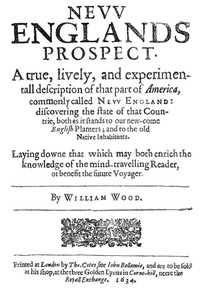
New Englands Prospect A true, lively, and experimentall description of that part of America, commonly called New England: discovering the state of that Countrie, both as it stands to our new-come English Planters; and to the old Native Inhabitants
by William Wood
"New Englands Prospect" by William Wood is a historical account written in the early 17th century. The work offers a detailed description of New England, exploring its geography, resources, wildlife, and the conditions experienced by both English settlers and Native Americans. It serves as both a guide for prospective settlers and a report on the region's natural wealth, addressing potential benefits and challenges for new arrivals. The opening of the text includes a preface addressing the reader and expressing the author's motivations for writing. Wood emphasizes his intent to provide an honest and experiential account of New England, countering misleading rumors and showcasing the region's advantages. He describes the pleasant landscape, emphasizes the healthful climate compared to England, and outlines its agricultural potential, including the rich soil and favorable conditions for a variety of crops and livestock. Such insights aim to encourage migration and investment into the area while presenting a practical understanding of its challenges, particularly regarding the severe winters.
Related Subjects
Bookshelves
Related books
The Women Who Came in the Mayflower
Annie Russell Marble
The Pilgrim fathers of New England : $b a history
W. Carlos (William Carlos) Martyn
Ye antient wrecke—1626 : $b Loss of the Sparrow-Hawk in 1626. Remarkable preservation and recent discovery of the wreck
Charles W. (Charles Walter) Livermore
Bradford's History of 'Plimoth Plantation' From the Original Manuscript. With a Report of the Proceedings Incident to the Return of the Manuscript to Massachusetts
William Bradford
The women of the Mayflower and women of Plymouth colony
Ethel J. R. C. (Ethel Jane Russell Chesebrough) Noyes
The New English Canaan of Thomas Morton with Introductory Matter and Notes
Thomas Morton
The Emancipation of Massachusetts
Brooks Adams