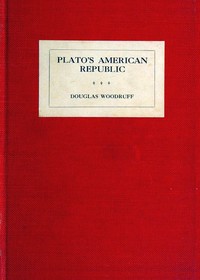
Plato's American Republic : $b Done out of the original
"Plato's American Republic" by Douglas Woodruff is a satirical philosophical dialogue written in the early 20th century. It stages Socrates and his companions debating the character of modern America, skewering its faith in Progress, mass opinion, industrialism, and reformist zeal. In playful Platonic fashion, the work takes aim at cars and commerce, Prohibition, politics, and higher education to question what a good life and a good polity require. The opening of the work places Socrates in “Athens, 1925,” where Agathon, Lysis, and Phaelon draw him into a comic-earnest inquiry sparked by an American who wants to buy the Parthenon. Agathon recounts Socrates’ disappointing U.S. lecture tour (outshone by Xantippe’s praise of American womanhood), which leads Socrates to dissect America’s worship of numbers and “Progress,” its fixation on automobiles, and the absurdities of parking and speed. The dialogue then widens to the Civil War’s legacy, the dominance of a vast federal machine, and the alliance of manufacturers and preachers (amplified by propaganda) in shaping “public opinion,” treated as a tyrant of souls. Socrates lampoons Prohibition as the product of that alliance (with women’s support), notes how it corrodes respect for law, and contrasts Ellis Island’s “undesirables” with the Statue of Liberty marooned offshore. Turning to education, he attacks swollen universities, fundraising presidents, timid faculties, and the cult of “facts” and experts, and proposes training a female guardian class to reorient the nation’s aims. The section closes with a plan to limit numbers and dethrone the card‑index mentality, all delivered in witty, Plato-like exchanges that mix satire with serious critique.
Related Subjects
Related books
Looking forward : $b a dream of the United States of the Americas in 1999
Arthur Bird
Appearances: Being Notes of Travel
G. Lowes (Goldsworthy Lowes) Dickinson
The Land of Contrasts: A Briton's View of His American Kin
James F. (James Fullarton) Muirhead
The Spirit of America
Henry Van Dyke
The Conquest of a Continent; or, The Expansion of Races in America
Madison Grant
The Twentieth Century American Being a Comparative Study of the Peoples of the Two Great Anglo-Saxon Nations
Harry Perry Robinson
Fenimore Cooper's Literary Offences
Mark Twain
What's What in America
Eugene V. (Eugene Valentine) Brewster