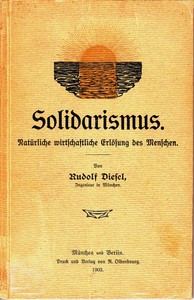
Solidarismus: Natürliche wirtschaftliche Erlösung des Menschen
"Solidarismus: Natürliche wirtschaftliche Erlösung des Menschen" by Rudolf Diesel is a socio-economic treatise written in the early 20th century. The work outlines Diesel's vision for a cooperative economic structure that empowers laborers through collective action, whereby individuals pool resources into a community fund known as the Volkskasse. The main concepts revolve around equitable economic distribution, working together for mutual benefits, and promoting welfare for all involved in the process, which is described through the metaphor of "Bienenstöcke" (beehives) where everyone's contributions lead to common gains. The opening of the work sets the foundation for the principles of Solidarismus, emphasizing the importance of ownership over one’s labor products and outlining the role of the Volkskasse in providing financial backing for various enterprises. Diesel introduces the idea of Brüder (brothers) contributing small amounts to create a collective capital that can provide credit for self-sustaining businesses. He explains how through cooperation, communities can achieve economic independence and prosperity, advocating for regular contributions to foster growth, security, and welfare for all members. This establishment of a supportive partnership among members becomes central to achieving the overarching goals of Solidarismus.
Related Subjects
Related books
The Servile State
Hilaire Belloc
A cityless and countryless world : $b An outline of practical cooperative individualism
Henry Olerich
Der Kollektivismus und die soziale Monarchie
Josef von Neupauer
The National Being: Some Thoughts on an Irish Polity
George William Russell
The Ethics of Coöperation
James Hayden Tufts
Solaris Farm: A Story of the Twentieth Century
Milan C. Edson
Mutual Aid: A Factor of Evolution
Petr Alekseevich Kropotkin