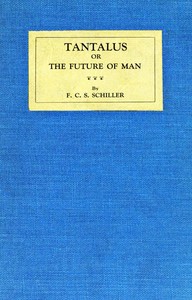
Tantalus : $b or, The future of Man
by F. C. S. (Ferdinand Canning Scott) Schiller
"Tantalus: or, The Future of Man" by F. C. S. Schiller is a philosophical essay written in the early 20th century. It explores profound questions about the future of humanity, focusing on the interplay between knowledge, moral responsibility, and the societal structures that govern human behavior. The book serves as a contemplative analysis of mankind's potential for both progress and destruction, encapsulating the reflections of a time grappling with the consequences of rapid scientific advancements and social changes. In this work, Schiller utilizes the myth of Tantalus to symbolize the dual nature of human existence—where tantalizing opportunities for happiness and progress are persistently just out of reach. The narrative begins with a prophetic oracle contemplating humanity's fate amid its accumulated knowledge, raising concerns about mankind's ability to make judicious choices. The text further discusses how civilization has arrested biological and moral progress, leading to a deterioration in societal values. Schiller argues for the necessity of moral introspection and institutional reforms, suggesting that while the biological evolution of humanity may be stalled, intellectual and cultural aspirations can still lead to a more enlightened future. Ultimately, the essay presents a nuanced perspective on the challenges and possibilities that lie ahead for humanity, urging the reader to confront and utilize knowledge responsibly to shape a better tomorrow.
Related Subjects
Related books
Essays in War-Time: Further Studies in the Task of Social Hygiene
Havelock Ellis
The Task of Social Hygiene
Havelock Ellis
Culture & Ethnology
Robert Harry Lowie
Parenthood and Race Culture: An Outline of Eugenics
C. W. (Caleb Williams) Saleeby
Woman and Womanhood: A Search for Principles
C. W. (Caleb Williams) Saleeby
History of Human Society
Frank W. (Frank Wilson) Blackmar
Eugenics as a Factor in the Prevention of Mental Disease
Horatio M. (Horatio Milo) Pollock
Emberi problémák
Sándor Tonelli