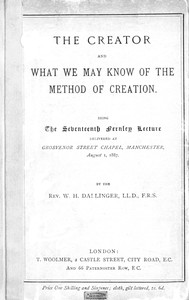
The Creator, and what we may know of the method of creation
by W. H. (William Henry) Dallinger
"The Creator, and What We May Know of the Method of Creation" by W. H. Dallinger is a philosophical discourse written in the late 19th century. This work explores the relationship between science and theology, particularly focusing on the existence of a divine creator in light of advancements in understanding the natural world. The book aims to engage thoughtful individuals who are interested in the interplay between modern science and the fundamental questions about existence and creation. The opening of this discourse sets the stage for a deep exploration of the philosophical implications of scientific inquiry. Dallinger examines the inherent drive of human consciousness to seek causation and understand the origins of the universe. He critiques various scientific attempts to explain phenomena purely in terms of matter and motion, arguing that such explanations ultimately fail to account for the existence of a creator or the deeper purpose of the universe. Through a careful examination of causality, consciousness, and the limits of physical science, Dallinger proposes that while science can illuminate the workings of nature, it cannot sufficiently address the fundamental truths regarding the divine mind that underpins existence.
Related Subjects
Bookshelves
Related books
Darwinism (1889) An exposition of the theory of natural selection, with some of its applications
Alfred Russel Wallace
The Gospel of Evolution From "The Atheistic Platform", Twelve Lectures
Edward B. Aveling
Legends of Babylon and Egypt in Relation to Hebrew Tradition
L. W. (Leonard William) King
Creative Evolution
Henri Bergson
The Evolution of Man Scientifically Disproved in 50 Arguments
William A. (William Asbury) Williams
Smithson's Theory of Special Creation
Noble Smithson
A Century of Science, and Other Essays
John Fiske
Mental Evolution in Man: Origin of Human Faculty
George John Romanes