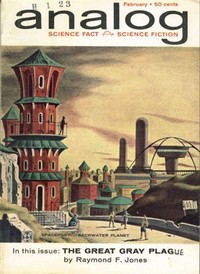
The Great Gray Plague
"The Great Gray Plague" by Raymond F. Jones is a science fiction novel written in the early 1960s. The story centers around Dr. William Baker, a 50-year-old director at the National Bureau of Scientific Development, and explores themes of scientific progress, human creativity, and the conflict between established authority and unconventional thinking. The narrative touches upon Baker's pride in his achievements, yet sets the stage for conflict as he interacts with colleagues and faces unexpected challenges, hinting at the emerging crisis that will unfold in response to a mysterious phenomenon. At the start of the novel, we meet Dr. Baker on his fiftieth birthday, where he receives a heartfelt surprise from his staff that underscores the camaraderie of his work environment. However, the tone quickly shifts as Baker's day progresses, revealing a tension between him and his friend Dr. John Fenwick, who is seeking a research grant for Clearwater College. Their conversation exposes the rigid criteria the Bureau employs to judge grant applications, including ludicrous evaluations of faculty backgrounds and cultural contributions, which irritate Fenwick. Baker's disdain for unconventional ideas and his adherence to the bureaucratic processes set up a conflict when a seemingly crackpot inventor, Jim Ellerbee, presents a potentially revolutionary communication device that challenges Baker's established views and beliefs about what constitutes legitimate scientific inquiry. The opening thus hints at a deeper exploration of creativity, human ingenuity, and the limitations imposed by rigid academic structures.
Related Subjects
Related books
The Ultroom Error
Jerry Sohl
Equation of Doom
Gerald Vance
Electro-episoded in A.D. 2025
E. D. Skinner
Yhdenvertaisuus
Edward Bellamy
Frank Reade Jr. and His Engine of the Clouds Or, Chased Around the World in the Sky
Luis Senarens
The Planet Savers
Marion Zimmer Bradley
Meddler's Moon
George O. (George Oliver) Smith
One of three
George O. (George Oliver) Smith