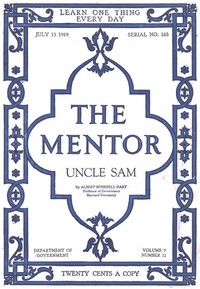
The Mentor: Uncle Sam, Vol. 7, Num. 11, Serial No. 183, July 15, 1919
"The Mentor: Uncle Sam, Vol. 7, Num. 11, Serial No. 183, July 15, 1919" by Albert Bushnell Hart is an informative publication written in the early 20th century. This book functions as a historical account, exploring the multifaceted nature of the figure of Uncle Sam as a symbol of the United States government and its various departments and services. It delves into the roles Uncle Sam plays in public health, education, agriculture, commerce, labor, and military service, particularly in the context of post-World War I America. The content of the book highlights Uncle Sam's significance in American life by detailing how the government supports its citizens through various programs. Hart describes the operations of the Public Health Service, the Bureau of Education, the Department of Agriculture, and other federal institutions that work to ensure the well-being and advancement of the populace. The narrative encapsulates the evolution of these departments and their efforts in educating citizens, securing labor rights, providing medical aid, and promoting commerce and agriculture, ultimately portraying Uncle Sam as the embodiment of the nation's commitment to its people. Through compelling prose, the work underscores the government's role as a protective and nurturing entity, striving for the prosperity and growth of the American society.
Related Subjects
Bookshelves
Related books
An old master, and other political essays
Woodrow Wilson
Congressional government : $b a study in American politics
Woodrow Wilson
Political Recollections 1840 to 1872
George Washington Julian
American Political Ideas Viewed from the Standpoint of Universal History
John Fiske
Civil Government in the United States Considered with Some Reference to Its Origins
John Fiske
The Wars Between England and America
Theodore Clarke Smith
Unpopular government in the United States
Albert Martin Kales
The Boss and the Machine: A Chronicle of the Politicians and Party Organization
Samuel Peter Orth