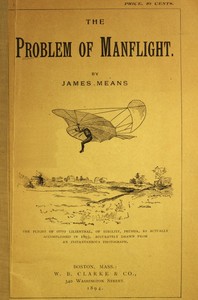
The Problem of Manflight
by James Means
"The Problem of Manflight" by James Means is a scientific publication written in the late 19th century. The book explores the complexities and theories surrounding human flight, focusing on aerodynamics and the mechanics involved in flight through the lens of contemporary scientific understanding. Means evaluates competing theories on aviation, discussing various methods and principles that might enable man to successfully navigate the skies. The text delves deeply into the mechanics of flight, drawing comparisons between birds and potential flying machines. Means articulates the significant role of gravitation and momentum in overcoming air resistance, suggesting that, unlike traditional methods relying on propulsion, future flying machines may harness natural forces such as wind. He outlines experimental methods, like the use of soaring machines and captive balloons, to test and realize these concepts, advocating for further exploration and innovation in aeronautics. Means' work not only highlights the existing knowledge of his time but also serves as a call to action for future experimentation and development in the field of aviation.
Related Subjects
Bookshelves
Related books
Animal Locomotion; or, walking, swimming, and flying With a dissertation on aëronautics
James Bell Pettigrew
Building and Flying an Aeroplane A practical handbook covering the design, construction, and operation of aeroplanes and gliders
Charles B. (Charles Brian) Hayward
Dirigible Balloons
Charles B. (Charles Brian) Hayward
Langley Memoir on Mechanical Flight, Parts I and II Smithsonian Contributions to Knowledge, Volume 27 Number 3, Publication 1948, 1911
S. P. (Samuel Pierpont) Langley
Balloons, Airships, and Flying Machines
Gertrude Bacon
Opportunities in Aviation
Arthur Sweetser
Flying Machines Today
William D. (William Duane) Ennis
The Boys' Book of Model Aeroplanes How to Build and Fly Them: With the Story of the Evolution of the Flying Machine
Francis A. (Francis Arnold) Collins