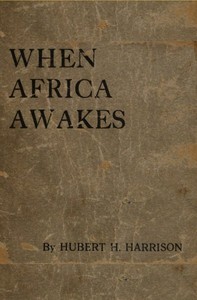
When Africa awakes The "inside story" of the stirrings and strivings of the new Negro in the Western world
"When Africa Awakes" by Hubert H. Harrison is a collection of essays and editorials written around the early 20th century, particularly during the aftermath of World War I. The work explores themes of race, democracy, and the emerging political consciousness of African Americans and the broader Afro-diaspora. Harrison articulates the urgent demand for civil rights and racial justice, highlighting the double standards faced by black individuals in America during a period when democracy was being championed worldwide. The opening of the book introduces the context of its creation, framing it as a response to significant social injustice following the war. Harrison discusses the formation of the Liberty League, a group advocating for the rights of African Americans, and underscores the urgency of their demands. The first chapter details a mass meeting that brought together Negro Americans in protest against systemic violence, specifically lynching and discrimination, while expressing a collective desire for the acknowledgment of their contributions and rights in a nation proclaiming democracy. Harrison's tone is assertive, emphasizing a shift from passive requests to active demands for rights and justice, indicative of the revolutionary spirit rising among the black population in that era.
Related books
A Glance at the Past and Present of the Negro: An Address
Robert H. (Robert Heberton) Terrell
A Comparative Study of the Negro Problem The American Negro Academy. Occasional Papers No. 4
Charles C. (Charles Chauveau) Cook
The slave trade : $b Slavery and color
Theodore D. (Theodore Dehon) Jervey
The Freedmen's Book
Lydia Maria Child
Civilization the Primal Need of the Race, and The Attitude of the American Mind Toward the Negro Intellect The American Negro Academy. Occasional Paper No. 3
Alexander Crummell
A Mississippi View of Race Relations in the South
Dunbar Rowland
The American Prejudice Against Color An Authentic Narrative, Showing How Easily the Nation Got into an Uproar.
William G. Allen
The Soul of John Brown
Stephen Graham