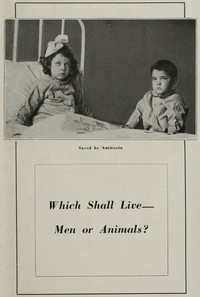
Which Shall Live—Men or Animals?
"Which Shall Live—Men or Animals?" by Ernest Harold Baynes is a scientific publication that addresses the ethical and practical implications of animal experimentation, particularly in the context of medical advancements. Written in the early 20th century, the book debates the necessity of using animals for research that ultimately benefits human health. Baynes argues that the progress made in medicine is largely due to experiments conducted on various mammals, thus highlighting the ongoing struggle between human welfare and animal rights. The book outlines several crucial medical breakthroughs achieved through animal experimentation, such as the development of vaccines and treatments for diseases like bubonic plague and diabetes. Baynes emphasizes that many life-saving techniques were perfected on animals before being applied to humans, showcasing the vital role that these experiments play in advancing medical knowledge. He also critiques the antivivisection movement, asserting that misconceptions and extremist views can hinder scientific progress and threaten public health. Overall, the work serves as a defense of the practice of vivisection in the interest of saving human lives, while also addressing ethical considerations surrounding the treatment of experimental animals.
Related Subjects
Related books
An ethical problem; or, Sidelights upon scientific experimentation on man and animals
Albert Leffingwell
Vivisection
Albert Leffingwell
The Pros and Cons of Vivisection
Charles Richet
Experiments on Animals
Stephen Paget
Great Testimony against scientific cruelty
Stephen Coleridge
The Vivisectors' Directory Being a list of the licensed vivisectors in the United Kingdom, together with the leading physiologists in foreign laboratories
Unknown
Animals' Rights Considered in Relation to Social Progress
Henry S. Salt