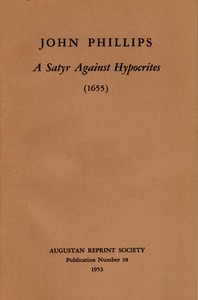
A Satyr Against Hypocrites
"A Satyr Against Hypocrites" by John Phillips is a satirical poem written in the mid-17th century, specifically around the time of the English Civil War. This work employs sharp wit and humor to critique religious hypocrisy, with particular targets being the discrepancy between outward piety and internal moral corruption among religious figures and the laity of the time. The poem is characterized by its lively depiction of various churchgoers and their behaviors, reflecting Phillips' commentary on the society of his era. In the poem, Phillips paints a vivid picture of a congregation attending a church service, delving into the antics and absurdities of the various characters present, including the vain women, greedy parishioners, and self-righteous clergy. Through a series of humorous and often grotesque vignettes, he explores themes of religious pretense, the folly of blind zeal, and the disgraceful behaviors that contradict their professed beliefs. Phillips’ use of striking imagery and witty language brings to life a compelling narrative that critiques not only religious hypocrisy but also the broader societal issues of his time, making it a lively, if critical, reflection of 17th-century English life.
Related Subjects
Bookshelves
Related books
Great Men as Prophets of a New Era
Newell Dwight Hillis
Oliver Cromwell
Samuel Rawson Gardiner
A Body of Divinity, Vol. 1 (of 4) Wherein the doctrines of the Christian religion are explained and defended, being the substance of several lectures on the Assembly's Larger Catechism
Thomas Ridgley
A Body of Divinity, Vol. 2 (of 4) Wherein the doctrines of the Christian religion are explained and defended, being the substance of several lectures on the Assembly's Larger Catechism
Thomas Ridgley
A Body of Divinity, Vol. 3 (of 4) Wherein the doctrines of the Christian religion are explained and defended, being the substance of several lectures on the Assembly's Larger Catechism
Thomas Ridgley
A Body of Divinity, Vol. 4 (of 4) Wherein the doctrines of the Christian religion are explained and defended, being the substance of several lectures on the Assembly's Larger Catechism
Thomas Ridgley
Oliver Cromwell and the Rule of the Puritans in England
C. H. (Charles Harding) Firth
Oliver Cromwell
Theodore Roosevelt