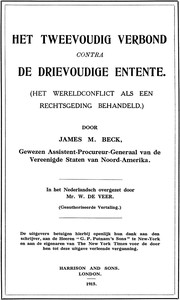
Het tweevoudig verbond contra de drievoudige Entente (het wereldconflict als een rechtsgeding behandeld)
by James M. (James Montgomery) Beck
"Het tweevoudig verbond contra de drievoudige Entente" by James M. Beck is a historical account written in the early 20th century. The book delves into the complex political dynamics and conflicts leading up to World War I, focusing on the moral and legal justifications behind the actions of the nations involved. It analyzes the diplomatic exchanges and decisions that escalated tensions, particularly examining the roles of Austria-Hungary and Germany in relation to Serbia and the international community. At the start of the narrative, the author sets up a hypothetical scenario where a World Civilization High Council could resolve the conflict brewing in 1914 through moral and ethical considerations rather than military force. Beck raises critical questions regarding the legitimacy of Austria’s declaration of war against Serbia, Germany’s involvement, and Britain's justification for its actions. He highlights the lack of moral reasoning among certain intellectuals and the manipulation of diplomatic correspondences, emphasizing the role of secretive negotiations and the consequences they had on the outbreak of war. This opening establishes a framework for the exploration of international law and ethics in wartime, clearly positioning the text as a critical analysis of the events leading up to one of the most consequential wars in modern history.
Related Subjects
Related books
The Cloud
Sartell Prentice
The Pentecost of Calamity
Owen Wister
Action Front
Boyd Cable
Doing Their Bit: War Work at Home
Boyd Cable
Front Lines
Boyd Cable
War Dogs of the World War
John I. Anderson
Pan-Germany : $b The disease and cure
André Chéradame
The Two Maps of Europe, and Some Other Aspects of the Great War
Hilaire Belloc