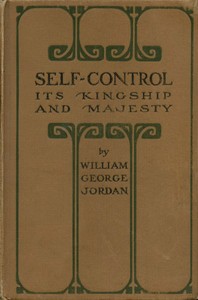
Self-Control, Its Kingship and Majesty
"Self-Control, Its Kingship and Majesty" by William George Jordan is a philosophical treatise written in the late 19th century. This work explores the concept of self-control as a vital virtue, asserting its importance in both personal development and the mastery over one’s life. The author delves into the nature of human potential, emphasizing that true greatness is not solely determined by innate qualities but rather by the cultivation of self-mastery and discipline. The opening of the book discusses the dual nature of man as both a product of divine creation and a self-creator. Jordan argues against the notion of fatalism, emphasizing that individuals hold the responsibility and potential to shape their destinies through self-control. He uses metaphors of kingship and servitude to illustrate how surrendering to one's weaknesses makes one a slave to circumstances, while mastering oneself transforms one into a ruler of one’s fate. The passage sets the tone for the ensuing chapters, which promise further exploration of the profound effects of self-discipline on personal success and happiness.
Related Subjects
Bookshelves
Related books
When a Man Comes to Himself
Woodrow Wilson
Seneca's Morals of a Happy Life, Benefits, Anger and Clemency
Lucius Annaeus Seneca
A way of life : $b An address to Yale students Sunday evening, April 20th, 1913
William Osler
菜根譚前後集
Zicheng Hong
The Pleasures of Life
John Lubbock
Mental Efficiency, and Other Hints to Men and Women
Arnold Bennett
The Human Machine
Arnold Bennett
The Plain Man and His Wife
Arnold Bennett