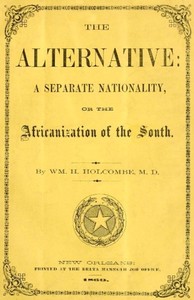
The Alternative: A Separate Nationality; or, The Africanization of the South
by William H. (William Henry) Holcombe
"The Alternative: A Separate Nationality; or, The Africanization of the South" by Wm. H. Holcombe, M.D. is a historical account written in the early 1860s. The book delves into the contentious debates surrounding slavery in the United States, particularly focusing on Southern perspectives amidst rising abolitionist sentiments in the North. Holcombe presents a defense of slavery as a necessary institution for both economic and moral reasons, arguing that it is essential for the Southern way of life and for the alleged upliftment of African people. In this treatise, Holcombe outlines what he perceives as an inevitable divide between Northern and Southern states, framing the struggle as one between the survival of slavery and the "Africanization" of the South. He argues that the abolition of slavery would not only lead to social and economic collapse in the South but also to a devastating loss of identity for the Southern states. Holcombe calls for Southern unity in the face of Northern aggression and maintains that the South must either establish a separate nation or face destruction. Throughout the work, he attempts to frame this division as a natural and providential outcome of differing cultural and racial ideologies, solidifying his pro-slavery stance against the tide of abolitionist thought.
Related Subjects
Related books
The Crisis of Eighteen Hundred and Sixty-One in the Government of the United States. Its Cause, and How It Should Be Met
Abel D. Streight
Lectures on the Philosophy and Practice of Slavery As Exhibited in the Institution of Domestic Slavery in the United States, with the Duties of Masters to Slaves
William A. (William Andrew) Smith
American slavery, and the means of its abolition
Jonathan Ward
Memories of Childhood's Slavery Days
Annie L. Burton
The Uprising of a Great People The United States in 1861. to Which is Added a Word of Peace on the Difference Between England the United States.
Agénor Gasparin
American Scenes, and Christian Slavery A Recent Tour of Four Thousand Miles in the United States
Ebenezer Davies
No Compromise with Slavery An Address Delivered to the Broadway Tabernacle, New York
William Lloyd Garrison
Thoughts on African Colonization
William Lloyd Garrison