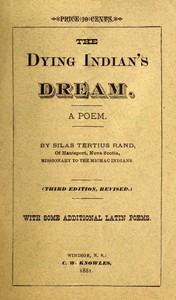
The Dying Indian's Dream: A Poem
"The Dying Indian's Dream: A Poem by Silas Tertius Rand" is a narrative poem written in the late 19th century. The work revolves around the final moments of an Indigenous man named John Paul, who reflects on his life's journey and his faith as he faces death. The poem explores themes of spirituality, cultural identity, and the hope for salvation, providing insight into the interactions between the Mic-Mac Indians and Christian missionaries during that era. In the poem, John Paul lies on his deathbed, recounting his life as a skilled hunter and loving father. While in his final moments, he experiences a vivid dream of heaven, filled with joy and the embrace of divine figures. As he transitions from life to death, he shares his visions with those around him, expressing immense peace and joy. His dream conveys a powerful sense of hope and comfort, as he envisions a welcoming and radiant afterlife where he will be reunited with loved ones. Ultimately, the poem serves as an uplifting testament to faith and the belief in eternal life amidst suffering and hardship.
Related Subjects
Bookshelves
Related books
Indian Legends and Other Poems
Mary Gardiner Horsford
God's drum, and other cycles from Indian lore
Hartley Burr Alexander
Powhatan; A Metrical Romance, in Seven Cantos
Seba Smith
Laulu Hiawathasta
Henry Wadsworth Longfellow
The Song of Hiawatha
Henry Wadsworth Longfellow
The Song of Hiawatha: An Epic Poem
Henry Wadsworth Longfellow
The Story of Hiawatha, Adapted from Longfellow
Henry Wadsworth Longfellow
American Indian love lyrics, and other verse, from the songs of the North American Indians
Unknown