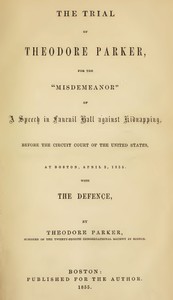
The Trial of Theodore Parker For the "Misdemeanor" of a Speech in Faneuil Hall against Kidnapping, before the Circuit Court of the United States, at Boston, April 3, 1855, with the Defence
"The Trial of Theodore Parker" by Theodore Parker is a historical account written in the mid-19th century. It documents the legal trial of Theodore Parker, a minister and outspoken abolitionist, for making a speech in Faneuil Hall against the kidnapping of fugitive slaves. The book delves into the broader implications of freedom of speech and the legal framework surrounding slavery in the United States during a tumultuous time. At the start of the book, the author lays out the charges against him after an indictment by a grand jury linked to his anti-slavery speech and detailed the context leading to his trial. Parker reflects on the political atmosphere, the implications of the fugitive slave bill, and the societal compulsion to silence voices advocating for human rights and justice. He asserts that the case is not merely about him; rather, it highlights a fundamental struggle between freedom and oppression that impacts the entire nation. His defense is framed as a noble cause—a plea for justice and moral integrity in the face of systemic corruption and human rights violations.
Related Subjects
Related books
Report of the Proceedings at the Examination of Charles G. Davis, Esq., on the Charge of Aiding and Abetting in the Rescue of a Fugitive Slave: Held in Boston, in February, 1851.
Charles G. (Charles Gideon) Davis
The Duty of Disobedience to the Fugitive Slave Act An Appeal To The Legislators Of Massachusetts, Anti-Slavery Tracts No. 9
Lydia Maria Child
Right and wrong in Massachusetts
Maria Weston Chapman
Fugitive Slave Law The Religious Duty of Obedience to Law : A Sermon by Ichabod S. Spencer Preached In The Second Presbyterian Church In Brooklyn, Nov. 24, 1850
Ichabod S. (Ichabod Smith) Spencer
A History of the Trial of Castner Hanway and Others, for Treason, at Philadelphia in November, 1851 With an Introduction upon the History of the Slave Question
Member of the Philadelphia bar
Speech of John Hossack, Convicted of a Violation of the Fugitive Slave Law Before Judge Drummond, Of The United States District Court, Chicago, Ill.
John Hossack
The Fugitive Slave Law and Its Victims Anti-Slavery Tracts No. 18
Samuel May
Cotton is King, and Pro-Slavery Arguments Comprising the Writings of Hammond, Harper, Christy, Stringfellow, Hodge, Bledsoe, and Cartrwright on this Important Subject
Unknown