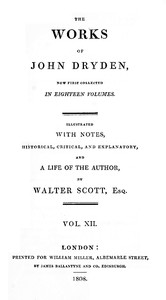
The works of John Dryden, now first collected in eighteen volumes. Volume 12
by John Dryden
"The Works of John Dryden, Now First Collected in Eighteen Volumes; Vol. 12" is a literary collection likely published in the early 19th century. This volume features a selection of Dryden's works, including notable translations from famous classical texts, indicating a focus on both original content and adaptations from authors such as Ovid and Chaucer. This collection not only showcases Dryden's poetic prowess but also serves as an exploration of themes such as love, fate, and the complexity of human emotions through his narratives. At the start of this volume, the narrative centers on "The Knight's Tale," derived from Chaucer. The tale introduces key characters Palamon and Arcite, two knights who find themselves imprisoned and both fall in love with the beautiful Emelie. A rivalry sparks between them upon seeing her, leading to their respective desperate prayers to the gods for victory and love. The themes of chivalry, the nature of love, and fate are set up as the knights prepare for a tournament that will determine who will win Emelie's hand. Through rich imagery and emotional depth, this opening portion provides a captivating glimpse into the conflicts and aspirations of its characters, setting a compelling stage for the rest of the tale.
Related Subjects
Bookshelves
Related books
Short Studies on Great Subjects
James Anthony Froude
The Works of Charles and Mary Lamb — Volume 1 Miscellaneous Prose
Charles Lamb
Quotations from the Project Gutenberg Editions of the Collected Works of George Meredith
George Meredith
Geschichte der Englischen Sprache und Literatur von den ältesten Zeiten bis zur Einführung der Buchdruckerkunst
Ottomar Behnsch
Junior High School Literature, Book 1
William H. (William Harris) Elson
The Illustrated London Reading Book
Various
The works of John Dryden, now first collected in eighteen volumes. Volume 02
John Dryden
The works of John Dryden, now first collected in eighteen volumes. Volume 04
John Dryden