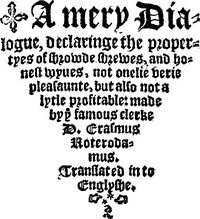
A Merry Dialogue Declaringe the Properties of Shrowde Shrews and Honest Wives
"A Merry Dialogue Declaringe the Properties of Shrowde Shrews and Honest Wives" by Desiderius Erasmus of Rotterdam is a humorous discourse written in the mid-16th century, likely around the 1550s. This dialogue fits within the genre of social commentary and satire, exploring marital dynamics and the contrasting tendencies of wives characterized as either 'shrowde shrews' or 'honest wives.' The text likely aims to entertain while also providing insights into the expected behaviors and roles within a marriage, reflecting the social norms of its time. The narrative unfolds through the conversations of two women, Eulalia and Xantippa, who exchange their experiences and perspectives on marriage and their husbands. Eulalia offers counsel to Xantippa, who complains about her husband's behavior and perceived shortcomings. The dialogue touches on themes of patience, understanding, and the dynamics of power and submission within the marital relationship. Through anecdotes and humor, the text conveys the idea that wives can influence their husbands' behavior through gentleness and domestic care while highlighting the challenges they face. It culminates in a comedic yet pointed commentary on marriage, suggesting that the ability to navigate these complexities is crucial for a harmonious relationship.
Related Subjects
Related books
Petrarch's Secret; or, the Soul's Conflict with Passion Three Dialogues Between Himself and S. Augustine
Francesco Petrarca
Tudor school-boy life: the dialogues of Juan Luis Vives
Juan Luis Vives
1601: Conversation as it was by the Social Fireside in the Time of the Tudors
Mark Twain
Dialogues of the Dead
George Lyttelton Lyttelton
A dialoge or communication of two persons Deuysyd and set forthe in the late[n] tonge, by the noble and famose clarke. Desiderius Erasmus intituled [the] pylgremage of pure deuotyon. Newly tra[n]slatyd into Englishe.
Desiderius Erasmus
A Modest Meane to Mariage pleasauntly set foorth by that famous Clarke Erasmus Roterodamus, and translated into Englishe by N.L.
Desiderius Erasmus
A Very Pleasaunt & Fruitful Diologe Called the Epicure
Desiderius Erasmus
Een twaalftal samenspraken Tot inleiding: Cd. Busken Huet's beschouwing over Erasmus
Desiderius Erasmus