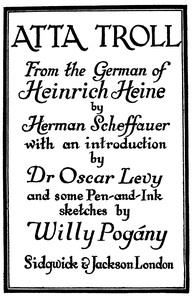
Atta Troll
"Atta Troll" by Heinrich Heine is a lyrical poem written in the early 19th century. This satirical work follows the titular character, Atta Troll, a dancing bear who represents the common people, as he escapes from human bondage and expresses his discontent with humanity's arrogance and inequality. The poem intertwines themes of social critique and romanticism, exploring ideas of freedom and the nature of existence through the lens of Heine's sharp wit and poignant observations. At the start of "Atta Troll," we are introduced to the bear's life in captivity, where he performs for human entertainment, despite the deep sorrow tied to his lost freedom. The narrative captures his tumultuous feelings toward his captors, conveying his anguish and rage at being reduced to a mere spectacle. Alongside Atta Troll, the story introduces Lascaro, a frail figure tied to the oppressive forces of feudalism, and his mother, the witch Uraka, who symbolizes the outdated traditions resisting change. This opening establishes a rich tapestry of characters and themes that set the stage for a thoughtful exploration of freedom, social justice, and the struggle against human arrogance.
Related Subjects
Bookshelves
Related books
Gaudeamus! Humorous Poems
Joseph Victor von Scheffel
Poems and Ballads of Heinrich Heine
Heinrich Heine
The poems of Heine; Complete Translated into the original metres; with a sketch of his life
Heinrich Heine
The Verse of Alfred Lichtenstein
Alfred Lichtenstein
Translations of German Poetry in American Magazines 1741-1810
Edward Ziegler Davis
The Ship of Fools, Volume 1
Sebastian Brant
Erotica Romana
Johann Wolfgang von Goethe
Faust — Part 1
Johann Wolfgang von Goethe